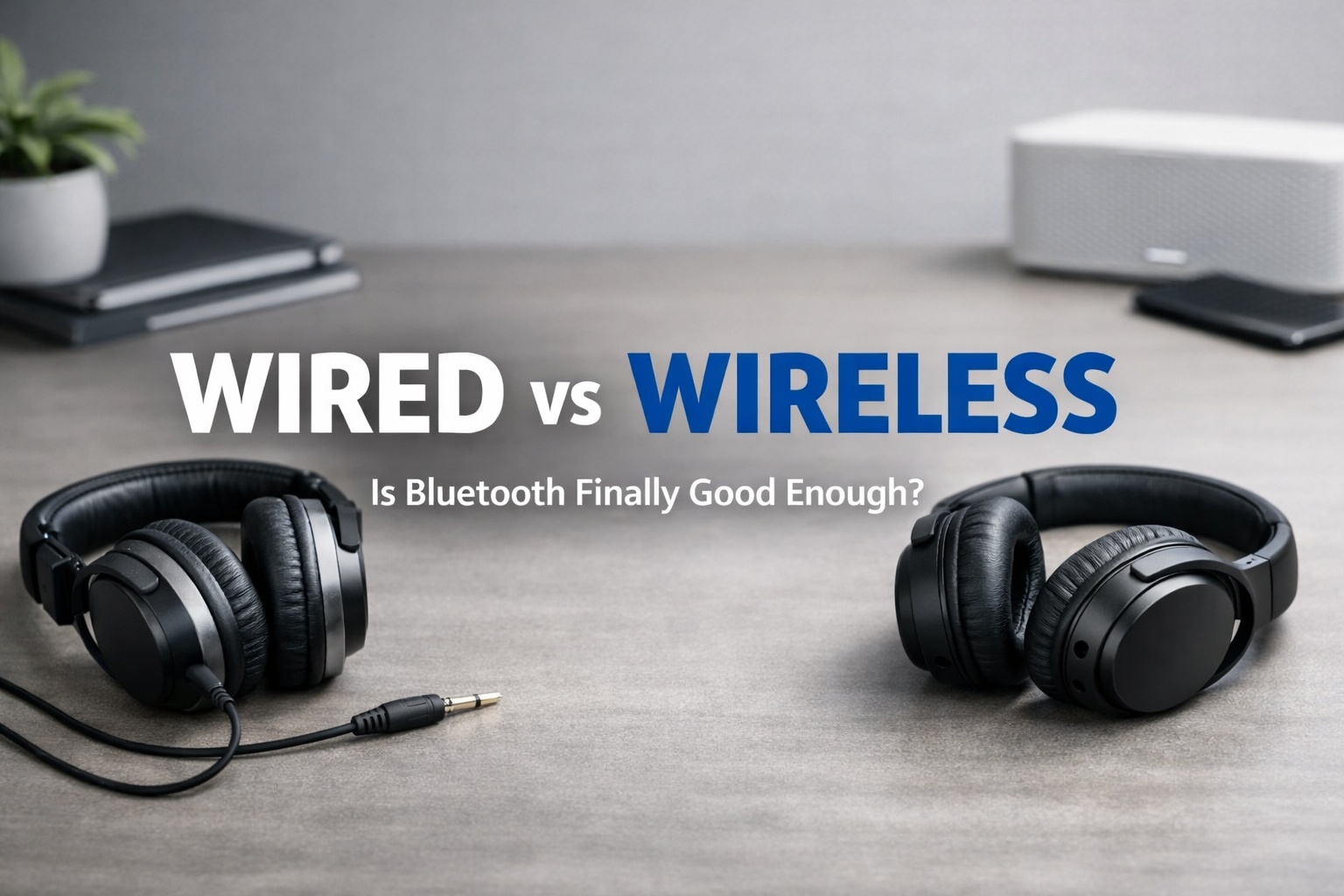
For years, the debate between wired and wireless headphones was simple: if you cared about sound quality, you went wired. If you cared about convenience, you went wireless. But in 2026, that line isn’t nearly as clear.
Bluetooth technology has improved dramatically. Premium wireless headphones now advertise high-resolution codecs, active noise cancellation, spatial audio, and multi-device pairing. Meanwhile, wired headphones still promise pure, uncompressed signal and zero latency.
So the real question becomes: Is Bluetooth finally good enough — or does wired still reign supreme?
Let’s break it down.
The Core Difference: How the Signal Travels
With wired headphones, audio travels as an electrical signal directly from your device (phone, laptop, DAC, amp) to your headphones through a cable. There’s no compression, no battery dependency, and almost no delay.
With wireless headphones, audio is transmitted over Bluetooth. That means:
- The audio is encoded (compressed).
- It’s transmitted wirelessly.
- It’s decoded inside the headphones.
- It’s amplified internally.
Each of those steps can affect sound quality — but modern Bluetooth has significantly reduced the impact.
Sound Quality: Is There Still a Noticeable Gap?
🎧 Wired Headphones: The Gold Standard
Wired headphones still offer:
- Lossless signal transmission
- Higher dynamic range potential
- No compression artifacts
- Better performance for high-impedance headphones
Audiophiles and studio professionals often prefer wired because it delivers exactly what the source provides — especially when paired with a quality DAC and amplifier.
If you’re mixing music, mastering tracks, or doing critical listening, wired is still the safer bet.
🔊 Wireless Headphones: Not What They Used to Be
Early Bluetooth audio sounded thin and compressed. Today, however, codecs have changed the game.
Modern codecs include:
- SBC (basic default codec)
- AAC (commonly used with Apple devices)
- aptX / aptX HD
- LDAC (Sony’s high-bitrate codec)
Higher-end codecs transmit more data, meaning better audio fidelity. In blind tests, many casual listeners can’t reliably distinguish high-quality Bluetooth from wired in everyday listening.
That’s a huge shift from even five years ago.
Verdict on sound quality:
Wired still wins technically — but for most listeners using streaming services like Spotify or Apple Music, high-quality wireless is more than good enough.
Latency: The Hidden Factor
Latency refers to delay between audio being produced and heard.
Wired = Near Zero Latency
Perfect for:
- Gaming
- Video editing
- Music production
- Watching movies without lip-sync issues
Wireless = Small Delay (Usually)
Bluetooth introduces latency because of encoding and transmission. While many modern headphones minimize delay, it can still matter for:
- Competitive gaming
- Real-time monitoring
- Instrument recording
Some headphones reduce delay using special codecs, but wired remains the safest choice if timing precision matters.
Convenience: Wireless Dominates
This is where wireless headphones shine.
Benefits include:
- No cable tangling
- No accidental cord pulls
- Easy mobility
- Seamless switching between devices
- Built-in microphones and touch controls
For commuting, traveling, workouts, and daily office use, wireless headphones are simply easier to live with.
And active noise cancellation (ANC), a feature commonly found in wireless models, is a major bonus for flights and busy environments.
Battery Life & Longevity
Here’s where wireless has a downside.
Wired Headphones:
- No battery required
- Can last 10+ years
- Fewer electronic components to fail
Wireless Headphones:
- Require charging
- Battery degrades over time
- Often harder to repair
Most wireless headphones last 20–40 hours per charge, which is excellent for daily use. But after 2–4 years, battery capacity may decline significantly.
If long-term durability matters, wired headphones are often the better investment.
Portability & Modern Devices
There’s a practical factor we can’t ignore: many modern smartphones no longer include a headphone jack.
This forces users to:
- Use a dongle
- Buy a USB-C DAC
- Or switch to wireless
Wireless headphones align more naturally with modern devices, especially for users who prioritize minimal gear.
Noise Cancellation: A Wireless Advantage
Active Noise Cancellation (ANC) is far more common in wireless headphones.
ANC uses microphones and digital processing to cancel background noise in real time — something passive wired headphones can’t replicate the same way.
For travel or shared workspaces, ANC can dramatically improve listening experience.
If isolation is your top priority, wireless models often provide the best solution.
Who Should Choose Wired?
Wired headphones are best for:
- Audiophiles who want the purest signal
- Studio professionals
- Competitive gamers
- Long-term durability seekers
- Budget buyers (great sound per dollar)
You typically get better raw audio performance per dollar with wired headphones.
Who Should Choose Wireless?
Wireless headphones are best for:
- Daily commuters
- Gym users
- Remote workers
- Travelers
- Anyone prioritizing convenience and mobility
The combination of portability, ANC, and improved sound makes wireless a strong all-around choice for most people.
What About Hybrid Options?
Some modern headphones offer both:
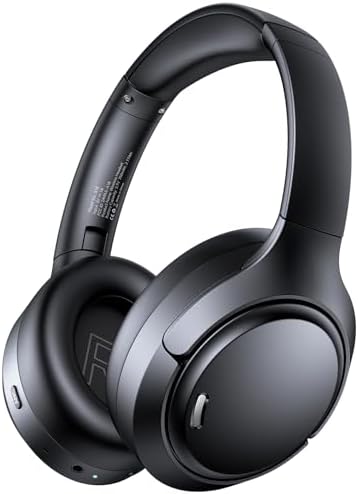
- Bluetooth connectivity
- Optional wired mode
This gives flexibility: wireless on the go, wired at your desk.
However, sound quality in wired mode on wireless headphones may not always match dedicated wired headphones in the same price range.
The 2026 Reality: Is Bluetooth Good Enough?
For the average listener? Yes — absolutely.
If you’re streaming compressed audio, listening casually, or using headphones for travel and work, modern Bluetooth headphones provide excellent sound with unmatched convenience.
But if you demand maximum fidelity, zero latency, and long-term durability, wired headphones still hold the technical edge.
The gap has narrowed dramatically — but it hasn’t disappeared entirely.
Final Verdict
Bluetooth is no longer the “compromise” it once was.
Wired headphones still win in:
- Pure sound accuracy
- Latency
- Longevity
Wireless headphones win in:
- Convenience
- Portability
- Noise cancellation
- Modern compatibility
In the end, the best choice isn’t about which is better universally — it’s about how you actually use your headphones.
If sound quality is your obsession, go wired.
If freedom and flexibility matter most, wireless may be all you need.
And for many people today, Bluetooth is finally good enough.
Affiliate Disclosure: As an Amazon Associate, I earn from qualifying purchases. This post contains affiliate links, which means if you click and make a purchase, I may receive a small commission at no extra cost to you. I only recommend products I personally use or believe add real value. Thank you for supporting The Right Man Mindset.