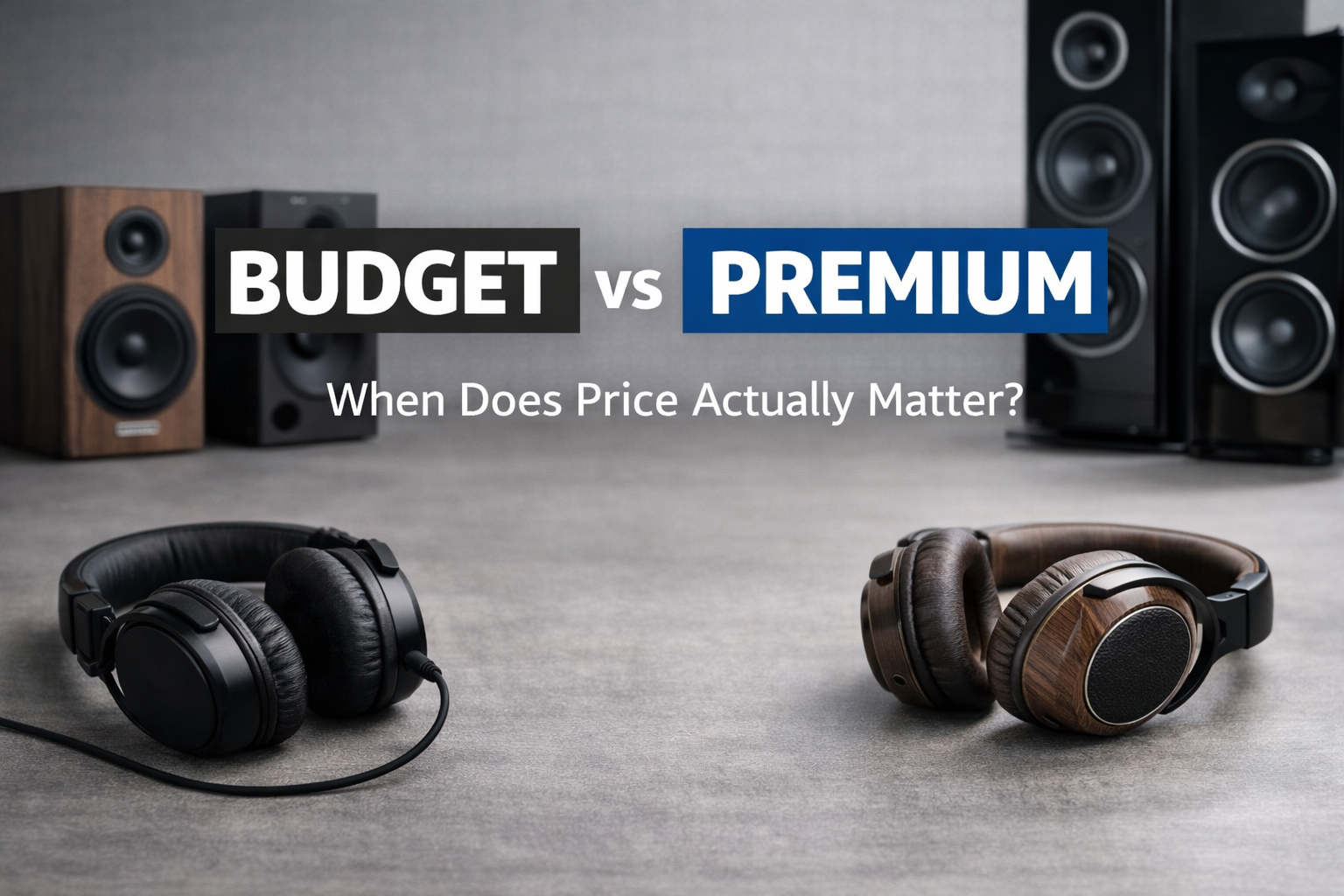
If you’ve spent any time researching audio gear, you’ve seen budget vs premium audio gear:
$99 headphones… right next to $1,999 headphones.
$300 speakers… beside $10,000 speakers.
The marketing promises are bold. “Unmatched clarity.” “Reference-grade detail.” “Audiophile performance.”
But here’s the real question: Does spending more actually mean better sound — or are you paying for hype?
Let’s break budget vs premium audio gear.
The Law of Diminishing Returns in Audio
Audio follows a very predictable curve:
- The jump from $50 → $200 is huge.
- The jump from $200 → $500 is noticeable.
- The jump from $500 → $1,500 is subtle.
- The jump from $1,500 → $5,000+ is often tiny.
That’s diminishing returns.
Entry-level gear often cuts corners in:
- Driver quality
- Materials
- Tuning precision
- Durability
But once you hit mid-range pricing, improvements become refinements rather than transformations.
Where Budget Gear Wins
Modern budget audio gear is better than ever.
You can now get:
- Clean, balanced headphones under $150
- Excellent powered bookshelf speakers under $300
- Solid DACs for under $100
For casual listeners, gamers, commuters, and even many home office users, budget gear delivers 80–90% of what premium gear offers.
And in blind listening tests, many people struggle to consistently identify ultra-expensive gear when volume-matched properly.
That’s important.
Where Premium Gear Actually Makes a Difference
Premium audio gear tends to improve in four key areas:
1️⃣ Detail & Resolution
Higher-end drivers can reproduce subtle textures — background instruments, breath in vocals, room reverb.
2️⃣ Soundstage & Imaging
Better separation between instruments. A more spacious “3D” presentation.
3️⃣ Build Quality
Metal frames, replaceable cables, higher-grade components.
4️⃣ Tuning Precision
Premium brands often spend more time engineering balanced frequency response.
For trained listeners in controlled environments, these differences matter.
The Marketing Problem
The audio world is filled with:
- Exotic cable claims
- “Burn-in” myths
- Overstated frequency response numbers
- Luxury branding markups
Not every expensive product is a scam — but not every expensive product delivers proportional performance either.
Price does not automatically equal performance.
The 80/20 Rule in Audio
You can usually get 80% of elite sound quality for 20–30% of the price.
That sweet spot is often:
- Mid-range headphones ($200–$400)
- Mid-range speakers ($400–$800 per pair)
- Affordable DAC/amp combos
Beyond that, you’re often paying for:
- Incremental improvements
- Brand reputation
- Aesthetic design
- Rarity or craftsmanship
For some buyers, that’s worth it. For others, it’s not.
When You Should Spend More
Premium gear makes sense if:
- You do professional audio work
- You critically listen to high-resolution files
- Your room is acoustically treated
- You’ve already upgraded your source and amplification
- Audio is your primary hobby
High-end gear reveals weaknesses elsewhere in your chain. If your source is compressed streaming audio, ultra-premium gear won’t magically fix that.
When Budget Is More Than Enough
Budget gear is ideal if:
- You stream from Spotify, Apple Music, or YouTube
- You listen casually
- You use headphones mostly for commuting
- Your listening environment isn’t optimized
In these scenarios, spending thousands may not deliver noticeable value.
The Room Factor (Often Overlooked)
Before upgrading from $800 speakers to $3,000 speakers, consider this:
Room acoustics can impact sound more than price tier.
Untreated reflections, poor speaker placement, and room shape can erase the advantages of expensive gear.
Sometimes a $200 investment in room treatment improves sound more than a $2,000 speaker upgrade.
Blind Testing Reality
Controlled blind tests frequently show:
- Listeners struggle to identify price tiers
- Volume differences trick perception
- Branding influences expectation
This doesn’t mean high-end gear isn’t better — it means the improvement may not match the price jump for most people.
Emotional Value vs Measurable Value
There’s another dimension: enjoyment.
Premium gear often:
- Feels better
- Looks better
- Inspires pride of ownership
And that emotional satisfaction is real value — even if the measurable audio improvement is smaller.
If audio is your passion, that premium experience can be worth the investment.
Final Verdict
Budget gear today is incredibly good.
Premium gear is better — but often by smaller margins than marketing suggests.
The smartest path usually looks like this:
- Start budget or mid-range.
- Upgrade only if you clearly hear limitations.
- Improve room acoustics before chasing ultra-high-end gear.
In audio, price matters — but not as much as you might think.
Affiliate Disclosure: As an Amazon Associate, I earn from qualifying purchases. This post contains affiliate links, which means if you click and make a purchase, I may receive a small commission at no extra cost to you. I only recommend products I personally use or believe add real value. Thank you for supporting The Right Man Mindset.